

DINOSAUR DISCUSSION 12
Sedimentation or Erosion?
Where did the dinosaurs come from?
Were they part of the creation?
Were they bred by the antediluvians?
Audience: Young Earth Christians
OK this discussion is looking at the geologic column. Or at least the general beliefs that Christians have about how these layers of rock came into existence. And all around the world there are many examples of these exposed eroded rock layers readily found.
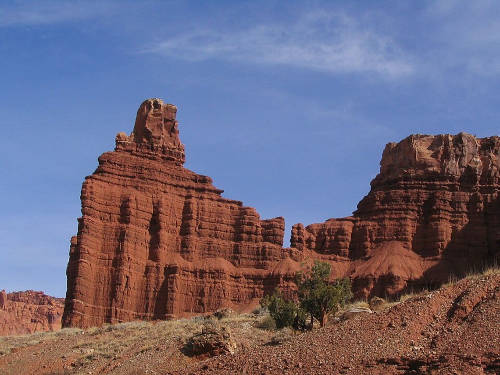
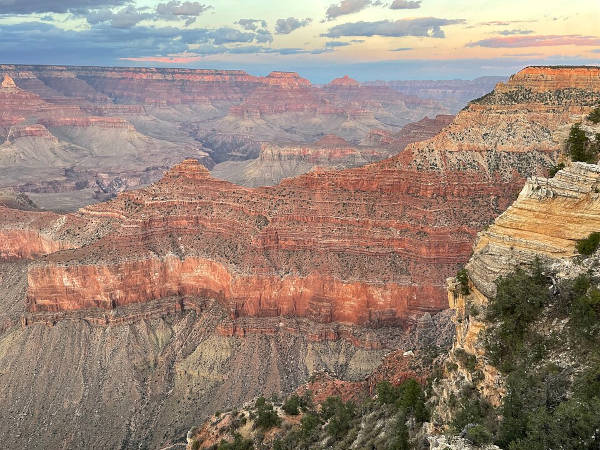
Of course evolutionists will tell us these rock layers formed over millions of years, or at least millions of years ago, even if they took less than a million years to form individually. And with many many layers you would easily get millions of years or at least close. But Christians have a different view on how long ago these layers were formed...
Erosion of Grand Canyon Within the Biblical Account of Earth History
Not long after all the fossil-bearing sedimentary layers of the Colorado Plateau had been deposited by the rising Flood waters, those same waters began to recede. We are told in Psalm 104:8 that at the end of the Flood, the mountains rose and the valleys sank down, causing the waters to drain off the continents back into new ocean basins. Massive sheet erosion occurred across the plateau while it was being uplifted, carving the Grand Staircase and leaving behind the colored cliffs, canyons like Zion Canyon, and isolated remnants like Red Butte.
answersingenesis.org/geology/grand-canyon-facts/when-and-how-did-the-grand-canyon-form/
OK this is clearly telling us that all these layers containing fossils were laid down at the time of the Flood and as the waters receded all this massive erosion occurred leaving us with these exposed eroded layers of rock that we see today.
Before I comment on this we need to look at one more quote, actually from the same page. It's a bit lengthy but just bear with it. You will see why:
Uplift of This Plateau Occurred Before Erosion of the Grand Canyon
This third observation also has profound implications concerning the origin of the Grand Canyon. At the eastern edge of the Kaibab Plateau, the sedimentary rock layers were bent, or as a geologist would say “folded,” along the East Kaibab Monocline at the time the plateau was uplifted. The uppermost folded layers have been beveled by erosion and overlaid by the flat-lying Wasatch Formation, which is younger. Furthermore, gravel deposits (from the Paleocene and Eocene epochs and thus younger than the folded Cretaceous layers) occur within channels eroded into the surface of the Kaibab Plateau, indicating the major uplift of the plateau and the accompanying erosion of its surface coincided with the uplift of the whole Colorado Plateau. Therefore, in evolutionary thinking the plateau is geologically “old,” and most evolutionary geologists believe its uplift occurred before erosion of the canyon into and through the plateau.
There is mention of folded Cretaceous layers in this and that's the layers containing dinosaurs! Well, at least the Cretaceous ones. So we should have dinosaur fossils in this mix. And the general view here is that these were deposited in layers formed at the time of the Flood. And this is the general Christian view. All these layers were deposited by the Flood and then eroded as the water receded leaving us today with all these exposed rock layers. And here the discussion is about the Grand Canyon.
I think we have a pretty good case to discuss here. And this definitely belongs in a discussion about dinosaurs!
Now this doesn't resolve the problem about where the dinosaurs came from, only that they were buried in these rock layers at the time of the Flood. They could have been created along with all the other animals in the Creation, or come about some other way by breeding in the antediluvian period to then perish in the Flood.
Or some could have been taken on the ark and died later in the early centuries after the Flood, or... maybe some are still alive hiding in the deepest darkest jungles somewhere just waiting to be discovered.
Well if you have looked at any of my earlier dinosaur discussions you know exactly where I am going.
So let's get into it! ...
The claim for the Christian view is that all the layers were formed at the Flood, and then eroded as the water receded, leaving all the exposed eroded layers that we find today. To erode solid rock layers requires that these layers were completely compacted, and formed, all within the time the Flood waters were on the earth. How long was this? Something like a year. Can ALL of these layers of rock been formed during this period of time?
So now the question is how long do rock layers take to form? I've tried to track fossil formation and it's a dog chasing its tail. How long is a piece of string? I eventually gave up and decided to focus on the rock layer formation time instead. It would vary of course on the type of rock, but that is where I ended up in discussion 0 [yes believe it or not there is a discussion zero!]
Anyway I resolved this problem by pulling some old text from discussion 5 [which now looks like it was overwritten in the correction phase--see 0 for reasons]. But we can pull this text now from zero so here it is...
Start of zero text:
From a youtube video[1] referring to a doc by Scott Dunn about clay depositions says something like "Basic soil mechanics shows that consolidation times for 1000 m-thick clay layers are in the order of millions of years".
So a conclusion is that each rock layer may have taken millions of years to go from sediment to solid rock. That may not be completely correct.
Scott Dunn was discussing clay layers with a lot of water and it was taking a LOT of time for the water to drain out. Also the millions of years time is for 1000 m thick clay layers.
So layers that are not formed from clay and a lot less than 1000 m thick may take a lot less time.
Sure, still a lot of time but maybe less than a million years.
What got me on this track is realizing a lot of megafauna have been found from the Late Pleistocene which supposedly covers between c. 129,000 and c. 11,700 years ago.
https://en.wikipedia.org/wiki/Late_Pleistocene
Anyway if a lot of fossils have been found from Late Pleistocene rock layers, then these layers couldn't have taken millions of years to form. ... [using natural processes of course]
End of old text.
Simply put it would be IMPOSSIBLE for ALL of these rock layers including all the fossils etc to have formed in LESS than ONE YEAR!!
So was the geologic column formed at the Flood and would this be possible?
If not possible they must have been formed before the Flood, to be solid enough to be eroded at the time of the Flood waters receding.
So there it is. You CAN'T have your cake and eat it!
Formed by sedimentation at the time of the Flood?
Or formed at some point before the Flood so they would be solid enough to then be eroded?
So which is it?
SEDIMENTATION?
or
EROSION?
That's the question.
And the problem of erosion brings this all to a head. This isn't something I actually considered at all. Though it was always there I just hadn't given it a deeper thought. But the answersingenesis page says it very bluntly. At the time of the Flood all these layers with buried animals becoming fossils were then with the receding waters reduced to what we see to day. And that's another point. We are not just talking about buried animals, but now FOSSILIZED buried animals! To coin a pun a VERY DIFFERENT type of animal altogether. OK no longer an animal but fossilized ROCK. Fossils are rocks:
Fossil
Fossils are the preserved remains, or traces of remains, of ancient organisms. Fossils are not the remains of the organism itself! They are rocks.
A fossil can preserve an entire organism or just part of one. Bones, shells, feathers, and leaves can all become fossils.
Fossils can be very large or very small. Microfossils are only visible with a microscope. Bacteria and pollen are microfossils. Macrofossils can be several meters long and weigh several tons. Macrofossils can be petrified trees or dinosaur bones.
https://web.archive.org/web/20240425044356/https://education.nationalgeographic.org/resource/fossil/
And though fossils can be made in a lab in a day, that's under laboratory conditions. Using normal rules of sedimentation, more likely many years. Could even be hundreds or thousands or millions of years depending what's being fossilized.
So large buried animals like dinosaurs becoming fossilized inside solid rock which again could take hundreds or thousands of years to form, just in time to be eroded by the receding Flood waters in less that a year? Not gonna happen. Didn't happen.
So if you believe in the erosion of these rock layers to what we have today, then they could not have been formed under normal sedimentary processes at the time of the Flood. They MUST have come into existence at some point in time BEFORE the Flood.
If you believe these rock layers were formed at the time of the Flood using normal methods of sedimentation then that's a whole other lot of problems.
The deposition of dinosaurs shows that this is just not possible. Like Noah throwing a large weight over the side of the ark. Where's it going to end up with all the sediments from the Flood forming below?
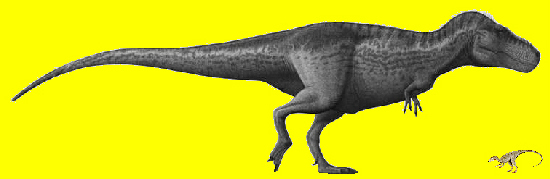
A heavy Tyrannosaurus rex weighing about 9 tonnes? Well that should go straight to the bottom, shouldn't it? And if Noah threw over something weighing the same as a Compsognathus [the little "compy" dinosaur] at about 2.5 kg. That weight would sink a bit but not as fast as the 9 tonne one. Clearly the smaller lighter dinosaur should end up in higher layers and the heavy larger dinosaur should be in the lower layers somewhere. NOT where they are currently found in the Mesozoic layers roughly in the middle of the geologic column.
This just clearly shows that the geologic column sedimentary layers containing fossils were NOT formed from the Flood! At least below the Flood boundary. Sure there were animals buried from the Flood but these are in the very top layers, like the Fens tree trunks that farmers keep digging up and complaining about.[See Discussion 5]
And there are some other anomolies that clearly show this.
Some curious dinosaur finds...
Dinosaur trackways have been found in multiple rock layers.
Nests have been found in multiple rock layers.
And one or more nests have been found containing young dinosaurs, one find with year-old dinosaurs.
See Discussion 2 for more about this. But quickly we have...
Multiple rock layers means these layers had to form before another one could be done. So many years between different trackways, and different nest sites. One-year-old young in a nest is another insurmountable problem with one quote author stating:
Irrespective of a watery or sandy death, the presence of a nest with juveniles in it presents a tremendous challenge to the global flood theory of creationists.[2]
Again, all these finds simply add more "evidence" that these rock layers were not deposited by the Flood of Noah.
So how about bending the rules a little?
Well, some Christians may say, couldn't God just have bent the rules a little and construced all these layers anyhow within the year span, for the receding Flood waters to then erode them to what we see today?
Well, umm, yes. But that is tantamount to my proposed model to answer this problem anyway. If God is going to bend the rules of normal sedimentation and fossilization, then why not just go the whole hog and have the geologic column [below the Flood boundary of course] be a complete fabrication? That solves the problem in one hit. And is my general or simplified Flood point model.
It's a fabrication. All the fossils simply then have been fabricated. Unfortunately that includes all the dinosaurs found in the Mesozoic layers. That's how these dinosaurs came into existence. In the rocks as fossils. They never existed as living breathing creatures at any time in the past. God did not create them along with all the other animals.
There were no dinosaurs in the Garden of Eden. Man and Dinosaurs never coexisted at any time in the past. According to this model they never existed before the Flood.
These are the conclusions we can draw from the answersingenesis quotes. We have to allow for normal processes of sedimentation and fossilization. And it is just not possible to have all animals buried and fossilized in completed formed solid layers of rock in a span of just a few months, so they can then be eroded.
Coupled with the problems of dinosaur deposition, multiple track layers, multiple nest layers, and year-old dinosaurs found in nests, the only conclusion that can be drawn is that these layers we are finding were not formed at the time of the Flood using normal rules of sedimentation and fossilization.
The only way they could have come about in that sort of a time frame is that they were fabricated.
This is my straight forward Flood point model. The geologic column below the Flood point containing all the fossil is a complete fabrication. I called this the simplified version.
However, at this point, the fourth model I have proposed gets very interesting. This is the Flood point model -church writings version[see Discussion 8].
It basically posits that the animals that were buried at the time of the Flood were to be an example that the world that was, perished by a Flood. It also has that the immense forests that were buried became the large coal layers that have been found. Though not stated these occur in the Carboniferous and the Cretaceous layers:
Coal formation
Coal is a solid, black, readily combustible fossil fuel that contains a large amount of carbon-based material - approximately 50% of its weight. The formation of coal takes a significant amount of time (on the order of a few million years), and the first coal-bearing rock units appeared about 290-360 million years ago, at a time known as the Carboniferous or "coal-bearing" Period. As well, there are extensive coal deposits from the Cretaceous age - about 65 to 144 million years ago.
https://energyeducation.ca/encyclopedia/Coal_formation
This does make a bit of a mess of my fabrication approach but I did fiddle with it and made an allowance for this though it is a bit of a stretch, and was the weak link in this model.
BUT
with this new information from the answersingenesis quote things are about to get a bit wonky with this model. Really wonky. Here's why. I never factored in this erosion that had to happen. Didn't really give it much thought. That's on me, but here we are so what does this mean for this model?
Here's a paraphrase of some parts from the church writings:
The Flood completely transformed the surface of the earth. As the waters receded, all around were the carcasses of animals and people that had perished.
God decided to bury everything so nothing was left to rot on the surface of the earth. With a great wind he dried up any remaining unnecessary water. This wind violently moved the water removing the tops of some of the mountains and piled up vegetation, earth and rocks completely covering all that had died.
End of paraphrase.
This variant changes everything! The general Christian view is that the animals that were buried by sedimentation must have happened as they died and the swirling waters mixed everything up with the rising sediment until we have a lot of layers containing the perished animals and with some time these layers turned to rock and the animals became fossilized. We mentioned this above where this obviously would have taken a lot of time, much much more than a year.
But the church writings approach turns this on its head. They weren't buried when they died. That happened at the end of the Flood with God drying up any remaining water AND then burying the carcasses of animals and people that had perished. And vegetation and rocks were then piled on top of them!
Now there is NO WAY that this gives us the geologic column, below the Flood boundary, as we now see it!
Interestingly this does NOT detract from the church writings at all. Excepting for the coal beds. It simply stated that animals and people perished in the Flood and were buried. Simple enough. And like the Fens logs would have been found in the upper layers. And where they are found.
Then as before, if this doesn't give us the geologic column as we see, below the Flood boundary, then again it must be a fabrication since it was NOT constructed from the Flood.
If you didn't get it, the eroded rocks we find are from the receding Flood waters. But the church writings model state the burial of animals and people occurred AFTER the majority of the Flood waters had receded. That's the inconsistency here. And it's a beauty!
As I said, the church model is OK, but it just does not give us the geologic column. Further this does make one mess, as the coal layers in the Carboniferous and the Cretaceous can not be from the Flood. And of course a fabrication here solves the problem. But not the comment that they were formed by the Flood.
Still not getting this? Try this... According to the answersingenesis quote, the receding Flood waters caused the massive erosion that we now see in the exposed rock layers. This is quite reasonable and most Christians would probably believe this. It makes sense, until you try to have the Flood also causing the layers to originally form from all the sediment and animals that died in the Flood and so on.
Of course that implodes when you factor the necessary time to form solid layers of rock and include fossilized animals, plants etc.
From this the simple conclusion is that these layers came into existence some other way and/or at an earlier time than the Flood. Either way they had to be a fabrication. For before the Flood this is a no brainer since it may not have rained before the Flood to be able to create all these sedimentary layers all around the world.
Anyway, we finally come to the problem. With the formation of all these layers [note I said all, and that includes the Cretaceous and the Carboniferous] we now come to the receding Flood waters and all the erosion that gives the rocks as we currently find them. AND now we come to the end of the Flood period and at this point God buries all the animals and people that had died heaping vegetation and rocks upon them.
IF this is when the massive forests were buried [or piled upon other stuff?] then what in the world is in the Cretaceous and Carboniferous layers way below which already exist and have shown some erosion from the receding Flood waters? This model posits that all the animals that perished were now buried on top of all these other layers containing fossils [from where??]. That's the problem.
As a result, this model simply resolves to my simplified Flood point model. The geologic column below the Flood point is simply a fabrication. That's it. So I lose a model and now only have three, with the church writings model coalescing into the simplified Flood point model. Still, it was an interesting run, which you can look at in Discussion 8.
As I said, the church writings model is fine but it doesn't give the geologic column as we now find it. The model simplifies to my general Flood point model. People and animals died and were buried and so on. And mainly in the top layers. And that works OK but the coal bed formation approach mentioned is a puzzle.
Well the resolution here is pretty simple, though may not be liked. The author of the church writings would have been using general Christian thoughts on the Flood with the majority of Christians believing that most of these rock layers were formed then.
The majority of Christians do believe this. That is an assumption but it is most likely correct.
With that thought the author would have been aware of the coal beds that had been found and would have simply connected this with the massive forests that were buried at the Flood. So it only makes sense that they would assume that these massive forests that had been buried at the time of the Flood mostly likely became the large coal beds that have been found.
This should not detract from these writings and have any affect on the underlying plan of salvation which the writings are generally about. In short this problem with coal beds is not a point that is essential to salvation. That's a simple Christian way of saying it. My thoughts on it and the best I can do at this point in time.
So that's about it.
REFERENCES
1.
The Mud Problem Precludes Young Earth Creationism
https://www.youtube.com/watch?v=uQcQSqH13xU
Gutsick Gibbon
Jun 14, 2024
OK not endorsing this site but there is a lot of interesting stuff here.
Note: this site is very much against a young Earth Creation.
See also:
2.
We live in a new golden age of fossil discoveries. It seems that every week a new and dramatic fossil find is revealed. This fossil renaissance can be attributed to the opening up of new fossil sources, particularly China and Mongolia but also South America and to improved technology for retrieving and analyzing fossil remains. One such remarkable fossil find from Mongolia was reported in late 2011.* This find involved 15 complete or nearly complete fossils of juvenile dinosaurs all preserved in what was apparently a large 2-3 foot wide nest. That fossil find is described in a research paper which I have read. The paper: “A nest of Protoceratops andrewsi (Dinosauria, Ornithischia)” by Fastovsky et al. (2011 in the Journal of Paleontology Vol 85:1035-1041) described the evidence that these dinosaurs were juveniles, that they were all likely the same age and thus were of one brood and were all huddled in the same nest.
In 2011 when I wrote about these fossils I stated that I was sure that within days Answers in Genesis and other creationists would be claiming these fossils as obvious evidence of a global catastrophe. I was absolutely correct and will show you their response at the end. But first let me observe that this obviously this is a case of rapid burial as their is little reason to believe that so many young dinosaurs of the same age would die in the same place and all oriented in the same direction in a nest under anything but unusual circumstances. But rapid burial doesn’t necessitate the jump to global flood. A watery death seems unlikely given that all 15 of these dinosaurs are in one nest, are of the same age (they didn’t just get washed there), and the sand grains of the rock they are embedded have the characteristics of sand dunes found today. A flood, whether placid or violent, would not be expected to result in this kind of preservation.
Irrespective of a watery or sandy death, the presence of a nest with juveniles in it presents a tremendous challenge to the global flood theory of creationists.
https://thenaturalhistorian.com/2014/01/31/juvenile-dinosaurs-found-huddling-in-a-nest-a-local-or-global-catastrophe/
T-rex
Tyrannosaurus
Temporal range: Late Cretaceous (Maastrichtian), 68–66 Ma
Tyrannosaurus[nb 1] is a genus of large theropod dinosaur. The species Tyrannosaurus rex (rex meaning "king" in Latin), often called T. rex or colloquially T-Rex, is one of the best represented theropods. It lived throughout what is now western North America, on what was then an island continent known as Laramidia. Tyrannosaurus had a much wider range than other tyrannosaurids. Fossils are found in a variety of rock formations dating to the Maastrichtian age of the Upper Cretaceous period, 68 to 66 million years ago. It was the last known member of the tyrannosaurids and among the last non-avian dinosaurs to exist before the Cretaceous–Paleogene extinction event.
The most complete specimen measures up to 12.3–12.4 m (40–41 ft) in length, but according to most modern estimates, Tyrannosaurus could have exceeded sizes of 12.4 m (41 ft) in length, 3.7–4 m (12–13 ft) in hip height, and 10 tonnes (9.8 long tons; 11 short tons) in mass.
https://en.wikipedia.org/wiki/Tyrannosaurus
https://commons.wikimedia.org/wiki/File:Tyrannosaurus-rex-Profile-steveoc86.png
Attribution: Steveoc 86
This file is licensed under the Creative Commons Attribution-Share Alike 4.0 International license.
Compsognathus
Temporal range: Late Jurassic, 150.8 Ma
Compsognathus (/kɒmpˈsɒɡnəθəs/; Greek kompsos/κομψός; "elegant", "refined" or "dainty", and gnathos/γνάθος; "jaw") is a genus of small, bipedal, carnivorous theropod dinosaur. Members of its single species Compsognathus longipes could grow to around the size of a chicken. They lived about 150 million years ago, during the Tithonian age of the late Jurassic period, in what is now Europe. Paleontologists have found two well-preserved fossils, one in Germany in the 1850s and the second in France more than a century later. Today, C. longipes is the only recognized species, although the larger specimen discovered in France in the 1970s was once thought to belong to a separate species and named C. corallestris.
The German specimen was estimated to have weighed 0.32 kg (0.71 lb) and 0.58 kg (1.3 lb), and the French specimen 2.5 kg (5.5 lb) and 3.5 kg (7.7 lb).
https://en.wikipedia.org/wiki/Compsognathus
“Compsognathus“
https://commons.wikimedia.org/wiki/File:Compsognathus_BW.jpg
Compsognathus longipes, a coelurosaur from the Late Jurassic of Europe, pencil drawing
Attribution: Nobu Tamura
This file is licensed under the Creative Commons Attribution 2.5 Generic license.
Licenses
CC BY 2.5
Creative Commons Attribution 2.5 Generic license.
https://creativecommons.org/licenses/by/2.5/
CC BY-SA 4.0
Creative Commons Attribution-Share Alike 4.0 International.
https://creativecommons.org/licenses/by-sa/4.0/
Stephen Buckley
E-mail: snoaktrua [at] duck.com
Last revised: 27 Sep 2026.
Constructed: Jun 2026.
Companion pages
Page design/construction Stephen Buckley 2026.
Snoaktrua